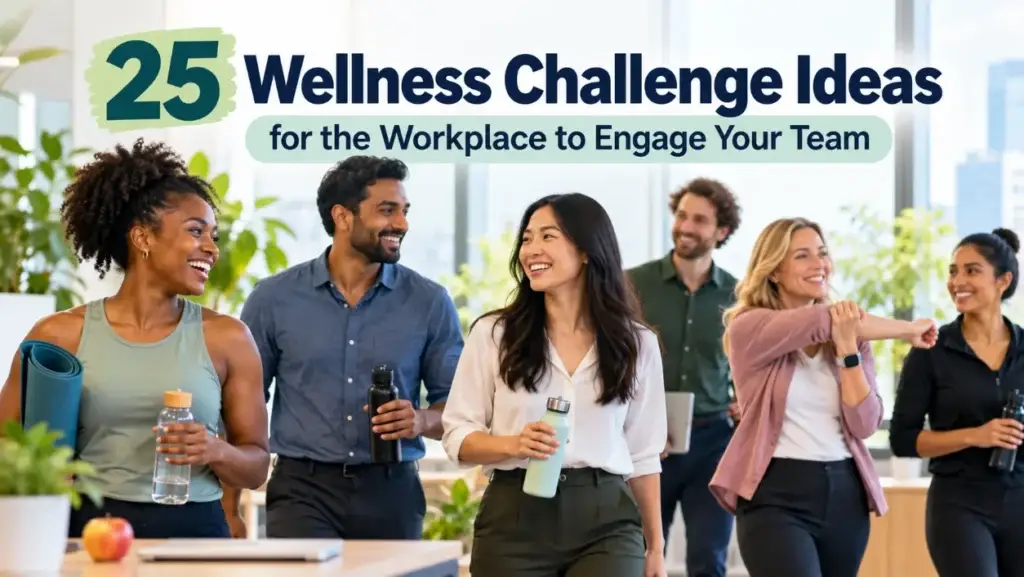
Looking for wellness challenge ideas for the workplace that employees can realistically participate in?
A workplace wellness challenge does not need to mean a competitive step leaderboard, a dramatic lifestyle overhaul or asking employees to share personal health information.
Some of the most practical challenges focus on small actions people can repeat for a limited period of time, such as taking an intentional break, getting outside, building a more consistent wind-down routine, connecting with coworkers or choosing one personal wellness goal.
The format matters too.
A good workplace wellness challenge should be easy to understand, simple to join and flexible enough to work for people with different roles, schedules, abilities and circumstances.
Below are 25 wellness challenge ideas for employees, followed by practical guidance for choosing the right format, deciding how long a challenge should run and encouraging participation without making wellness feel like another job requirement.
Planning a Wellness Challenge for Your Organization?
Choosing an idea is only the beginning. A challenge also has to fit your audience, goals, work environment, available time and resources.
FlavHer helps businesses, employers, residential communities, HOAs and organizations shape women-focused wellness experience concepts, engagement ideas, resources and recommendations.
What Is a Workplace Wellness Challenge?
A workplace wellness challenge is a defined activity or behavior employees are invited to practice over a set period of time.
Unlike a one-time workplace activity, a challenge usually includes:
- a clear start and end date,
- a simple goal or theme,
- repeated participation,
- an easy way to track progress if tracking is useful, and
- a clear explanation of how employees can participate.
A challenge might run for five days, two weeks, 30 days or four weeks depending on the goal.
For example, a company might run a two-week walking-break challenge where employees are invited to take one intentional walking break each workday.
Another organization might create a four-week challenge built around movement, recovery, connection and everyday wellness.
The challenge does not have to be competitive.
In fact, organizations should think carefully before designing wellness around competition, especially if the format favors people who are already highly active or asks employees to reveal information they would rather keep private.
NIOSH’s Total Worker Health approach describes workplace programs as most effective when worker health and wellbeing are considered alongside the actual conditions of work. It also emphasizes voluntary, participatory programs that give workers a voice in workplace offerings.
That is a useful foundation for any employee wellness challenge.
Workplace Wellness Challenges vs. Wellness Wednesday Activities
The two formats can work together, but they are not the same thing.
| Wellness Activity | Wellness Challenge |
|---|---|
| Usually happens once | Runs over a defined period |
| Example: Wednesday stretch session | Example: two-week movement-break challenge |
| Little or no progress tracking | May include simple progress tracking |
| Designed around an experience | Designed around repeated participation |
| Easy to rotate frequently | Usually needs clearer planning and communication |
If you are looking for lighter recurring activities rather than a structured challenge, explore our Wellness Wednesday ideas for work.
25 Wellness Challenge Ideas for the Workplace
1. Walking Break Challenge
Best length: 1–2 weeks
Invite employees to take one intentional walking break during each workday when their role and environment allow it.
Instead of tracking the highest number of steps, keep the challenge focused on participation.
For example:
“Take one walking break today.”
This lowers the barrier to entry and makes the challenge more accessible than a competition based entirely on step totals.
Employees who cannot or do not want to walk should be offered an equivalent way to participate, such as another comfortable movement or break option.
2. Movement Minutes Challenge
Best length: 2–4 weeks
Rather than counting steps, let employees choose the kind of movement that fits them.
This could include:
- walking,
- mobility work,
- stretching,
- strength training,
- cycling,
- swimming,
- dance, or
- another appropriate activity.
The challenge might simply be to include a small amount of intentional movement on participating days.
A flexible format avoids assuming everyone has the same fitness level, interests or physical abilities.
3. Stretch Break Challenge
Best length: 5–10 workdays
Encourage employees to step away from static work positions periodically and take a short optional movement or stretch break at their own comfort level.
If your organization wants to provide formal guided exercise, work with an appropriately qualified professional.
The internal challenge itself can remain simple:
“Take one intentional stretch or movement break during your workday.”
4. Personal Movement Goal Challenge
Best length: 30 days
Instead of giving everyone the same target, let each employee choose a realistic movement goal.
One person might decide to walk at lunch three times per week.
Someone else might choose two strength sessions per week.
Another employee might focus on mobility.
This creates a challenge structure without pretending that one goal is appropriate for everyone.
5. Hydration Habit Challenge
Best length: 1–2 weeks
The simplest version of a hydration challenge is not a contest to drink the most water.
Instead, encourage participants to make hydration easier during the workday.
Examples include:
- keeping water accessible,
- refilling a bottle during a break,
- choosing water with a meal, or
- creating another hydration reminder that works for them.
Avoid prescribing the same fluid target to every employee because individual needs vary.
6. Add-One-Nourishing-Food Challenge
Best length: 2 weeks
Instead of telling employees what foods they should remove, use an addition-based challenge.
Participants might choose to add something useful to their day, such as:
- a piece of fruit,
- vegetables with a meal,
- a protein source,
- a whole-grain option, or
- another food that helps them build a more satisfying meal.
Keep food messaging flexible and avoid labeling ordinary foods as “clean,” “bad” or “cheating.”
7. Bring-Your-Lunch Challenge
Best length: 1–2 weeks
For workplaces where it makes sense, invite employees to bring or prepare lunch on selected days.
The purpose does not have to be weight loss.
Instead, the challenge can focus on:
- planning ahead,
- trying new meal ideas,
- sharing recipes, or
- creating a lunch that works better for the employee’s workday.
Make the challenge optional and remember that buying lunch may be more practical for some employees.
8. Screen-Free Lunch Challenge
Best length: 5 workdays
Invite employees to spend part of their lunch break away from work screens where their role allows it.
They might:
- eat away from the desk,
- walk,
- sit outside,
- talk with coworkers, or
- simply take a genuine break.
This challenge works best when managers also respect lunch periods and avoid filling them with meetings.
9. Sleep Routine Challenge
Best length: 2–4 weeks
A workplace should not attempt to monitor employees’ sleep or diagnose sleep problems.
But a general education-based challenge can invite participants to choose one routine they want to make more consistent.
Examples might include:
- starting a wind-down routine,
- giving themselves enough time for sleep,
- reducing unnecessary late-evening work, or
- creating a more consistent bedtime routine.
Persistent sleep concerns may require professional medical guidance.
10. Evening Wind-Down Challenge
Best length: 7–14 days
This is narrower than a general sleep challenge.
Employees choose one short evening routine that signals the workday is over.
Examples include:
- putting work devices away,
- preparing for the next morning,
- reading,
- taking a quiet break,
- stretching, or
- using another personally appropriate wind-down habit.
If everyday fatigue is a recurring topic for your audience, FlavHer’s guide to a women’s energy boost explores practical habits related to energy, movement, food and recovery.
11. Five-Minute Reset Challenge
Best length: 5–10 workdays
Ask employees to take one intentional five-minute reset during the workday.
They might:
- step away from the screen,
- walk,
- stretch,
- sit somewhere quieter,
- clear their workspace, or
- simply pause between demanding tasks.
No complicated tracker is necessary.
A simple yes/no participation check is enough if you decide to track the challenge at all.
12. Mindful Break Challenge
Best length: 1–2 weeks
The goal is to create one brief period each workday when participants intentionally pause instead of automatically moving from one task to another.
Employees might use the break for quiet breathing, reflection, stretching, walking or another personally appropriate reset.
Avoid presenting the activity as treatment for stress, anxiety or another health condition.
13. Gratitude Challenge
Best length: 7 days
Invite participants to privately note one thing they appreciated each day.
The challenge does not need to require public sharing.
Employees can keep their reflections private or optionally contribute something to a shared board or channel.
Keeping participation low-pressure helps prevent the activity from becoming forced positivity.
14. Coworker Appreciation Challenge
Best length: 5 workdays
Create a simple challenge around recognizing helpful actions that often go unnoticed.
Participants might thank someone who:
- helped solve a problem,
- shared useful information,
- supported another team member,
- made a stressful day easier, or
- contributed quietly behind the scenes.
Shared practices like these can also reinforce community. FlavHer explores that broader idea in Creating Stronger Communities Through Connection.
15. Connection Challenge
Best length: 2 weeks
Invite employees to create one intentional point of connection during participating days.
That might mean:
- having coffee with a coworker,
- checking in with a teammate,
- joining an optional group lunch,
- meeting someone from another department, or
- having a short virtual coffee for remote teams.
Keep the format flexible for employees who prefer quieter or smaller social interactions.
16. Random Acts of Kindness Challenge
Best length: 5–10 workdays
This challenge can focus on small actions rather than spending money.
Examples include:
- helping a coworker,
- sharing a useful resource,
- giving thoughtful recognition,
- making space for someone else’s idea, or
- doing something that makes another person’s workday easier.
Avoid requiring employees to report every act publicly.
17. Outdoor Break Challenge
Best length: 1–2 weeks
When location, job role, weather and safety allow it, invite employees to take part of a break outdoors.
That might mean:
- a short walk,
- coffee outside,
- lunch outdoors, or
- a few minutes away from the normal workspace.
Remote employees can participate wherever they are.
18. Digital Boundary Challenge
Best length: 1–2 weeks
This challenge should focus primarily on realistic work boundaries rather than telling employees how to use their personal devices.
Possible actions include:
- taking a lunch break without work messages,
- using focus periods,
- turning off unnecessary work notifications,
- avoiding nonurgent after-hours communication, or
- creating clearer team communication expectations.
Leadership behavior matters here.
Employees cannot create meaningful digital boundaries if the workplace continues to expect immediate responses at all hours.
19. Workspace Reset Challenge
Best length: 5 workdays
Invite employees to improve one small part of their workspace each day.
That could include:
- clearing unnecessary clutter,
- organizing frequently used items,
- reviewing screen or chair positioning,
- improving lighting where possible, or
- removing one minor source of distraction.
Formal ergonomic or workplace-safety concerns should be handled by appropriately qualified personnel.
20. Take-Your-Break Challenge
Best length: 1–2 weeks
This may be one of the simplest workplace wellness challenges.
Employees are encouraged to actually use the breaks available to them where their work conditions allow.
The organization should support the challenge structurally too.
If workloads make it impossible for people to step away, sending reminders about wellness will not solve the underlying problem.
This is one reason workplace wellness should be understood more broadly than exercise or healthy snacks. Our guide to the difference between health and wellness explains that distinction in more detail.
21. Learn Something New Challenge
Best length: 2–4 weeks
Invite employees to spend a small amount of time learning something useful or interesting.
That could include:
- a professional skill,
- a wellness topic,
- a creative skill,
- a short course,
- a new recipe, or
- another subject they choose.
The challenge can end with an optional “what I learned” session or shared resource list.
22. Community or Volunteer Challenge
Best length: 1–4 weeks
Invite employees to participate in an organization-supported community activity.
Options might include:
- a donation drive,
- assembling care packages,
- supporting a local cause,
- volunteering during designated work time, or
- a community cleanup.
Avoid pressuring employees to donate their personal money or unpaid time.
23. Personal Wellness Goal Challenge
Best length: 30 days
Instead of selecting one wellness behavior for everyone, let participants choose their own realistic goal.
Possible areas include:
- movement,
- sleep routine,
- meal planning,
- taking breaks,
- connection,
- personal development, or
- another everyday wellness priority.
The goal should be chosen by the individual rather than assigned by their employer.
Employees who want a broader framework for choosing priorities can also use the principles in our personal wellness plan guide.
24. Team Wellness Bingo
Best length: 2–4 weeks
Create a bingo card with a variety of accessible activities so participants can choose their own route.
Squares might include:
- take an outdoor break,
- thank a coworker,
- eat lunch away from your screen,
- take a walking break,
- try a new meal,
- declutter one area,
- take a quiet reset,
- connect with someone new,
- finish work on time, or
- learn something new.
This format gives employees more choice than a challenge built around one single behavior.
25. Four-Week Whole-Wellness Challenge
Best length: 4 weeks
Instead of repeating one activity for an entire month, rotate through four broader themes.
For example:
- Week 1: Move – walking breaks, stretching or personal movement goals.
- Week 2: Recharge – breaks, boundaries, sleep routines or recovery.
- Week 3: Connect – appreciation, coffee connections or community activities.
- Week 4: Build – choose one habit worth continuing after the challenge.
This works particularly well when an organization wants variety without trying to run several separate wellness campaigns.
For additional month-long formats that individuals can adapt, explore our 30-day wellness challenge ideas.
Want to Create a Wellness Challenge That Fits Your Organization?
A list of ideas can provide inspiration. Designing a challenge around your people, goals, setting, schedule and available resources requires more thought.
FlavHer’s Wellness Experience Consulting helps businesses, employers, residential communities, HOAs and organizations develop women-focused wellness concepts, engagement ideas, recommendations, resources and aligned provider connections where appropriate.
Specialized services may be delivered by independent qualified professionals depending on the experience.
How Long Should a Workplace Wellness Challenge Last?
There is no ideal challenge length for every organization.
The right timeframe depends on how complicated the behavior is and how much commitment you are asking from employees.
| Challenge Length | Best For | Examples |
|---|---|---|
| 5–7 days | Testing a simple idea | Breaks, appreciation, outdoor time |
| 2 weeks | Repeating one manageable behavior | Walking breaks, hydration, connection |
| 30 days | Personal habit experimentation | Personal wellness goals, movement routines |
| 4 weeks | A structured workplace campaign | Whole-wellness or multi-theme challenge |
| Ongoing | Better treated as a workplace practice or program | Protected breaks, healthy work policies |
Longer is not automatically better.
If participation starts to feel like homework, the challenge may be asking too much.
How to Run a Workplace Wellness Challenge Employees Want to Join
Choose One Clear Purpose
Do not begin with the tracker.
Begin with the reason you are running the challenge.
Are you trying to encourage:
- more movement?
- better use of breaks?
- team connection?
- wellness education?
- a broader midyear reset?
- participation in a larger wellness initiative?
The goal should determine the format.
Ask Employees What Would Actually Be Useful
A challenge designed entirely by leadership may miss what employees actually want or need.
NIOSH’s Total Worker Health guidance emphasizes worker participation and giving workers a voice in workplace offerings.
That can be as simple as asking employees to vote between three challenge themes before you launch.
Make Participation Voluntary
Wellness becomes much less supportive when employees feel they will be judged for opting out.
Participation should not quietly become a measure of enthusiasm, loyalty or performance.
Keep the Rules Simple
If employees need a ten-minute explanation before they understand how to participate, simplify the challenge.
For example:
Complicated: Track your exact daily water intake, exercise minutes, sleep duration and meal score.
Simple: Choose one wellness action from the weekly list and mark the day complete.
Lower-friction challenges are easier to understand and maintain.
Give People More Than One Way to Participate
A step-only challenge may exclude employees who cannot or do not want to participate through walking.
A more inclusive movement challenge could allow:
- walking,
- chair movement,
- stretching,
- mobility,
- cycling,
- strength work, or
- another personally appropriate form of movement.
Avoid Unnecessary Health Data
You do not need an employee’s:
- weight,
- body measurements,
- diagnoses,
- medical history,
- calorie intake, or
- other sensitive health information
to run most workplace wellness challenges.
If the challenge can work without collecting sensitive information, leave that information private.
Do Not Make the Prize the Entire Point
A reward can make a challenge fun, but the program should not depend entirely on one employee winning.
Consider:
- participation recognition,
- team milestones,
- random drawings among participants,
- small shared celebrations, or
- noncompetitive completion recognition.
Give the Challenge Time During the Workday When Possible
If a company encourages wellness but expects every activity to happen before work, after work or during unpaid personal time, the message can feel inconsistent.
Where practical, allow employees to participate within normal working hours.
Leadership Should Follow the Same Rules
If leadership promotes a lunch-break challenge while scheduling meetings over lunch every day, employees will notice.
The work environment needs to support the behavior being encouraged.
The CDC Workplace Health Model similarly emphasizes coordinated and comprehensive approaches rather than relying on isolated individual behaviors.
How Should Employees Track a Wellness Challenge?
Use the least complicated tracking system that achieves the goal.
Options include:
- a simple paper checklist,
- a shared bingo card,
- a voluntary digital form,
- a team progress board,
- a yes/no completion tracker, or
- no formal tracker at all.
For many challenges, you do not need exact numbers.
“I participated today” may be enough.
The tracking method should not become more work than the challenge itself.
Should Workplace Wellness Challenges Be Competitive?
They can be, but they do not have to be.
Competition can motivate some employees while discouraging others.
If you use competition, consider formats where people are not rewarded simply for already being the most active person in the organization.
Alternatives include:
- team participation goals,
- department milestones,
- completion-based recognition,
- random prize drawings, or
- personal goals rather than one universal target.
The aim should be to invite participation, not identify the “healthiest” employee.
Workplace Wellness Challenge Ideas for Remote Teams
Remote employees can participate in many of the same challenges without creating another mandatory video call.
Good options include:
- walking-break challenges,
- five-minute reset challenges,
- digital boundary challenges,
- personal wellness goals,
- connection challenges,
- gratitude activities,
- outdoor breaks, and
- wellness bingo.
When possible, make the challenge something employees can do away from their screens.
Workplace Wellness Challenge Ideas for Hybrid Teams
Hybrid challenges should give remote and onsite employees equally meaningful ways to participate.
For example:
| Challenge | Onsite | Remote |
|---|---|---|
| Walking break | Walk outside or around the workplace | Walk near home or another appropriate location |
| Connection | Coffee or lunch with a coworker | Optional virtual coffee |
| Workspace reset | Office workstation | Home workspace |
| Outdoor break | Workplace outdoor area | Appropriate outdoor location near home |
The two versions do not need to be identical.
They should simply feel equally valid.
Common Workplace Wellness Challenge Mistakes
Making Everyone Do the Same Thing
Employees have different abilities, schedules, responsibilities and interests.
Build choice into the challenge where possible.
Making Weight Loss the Main Goal
Weight-focused challenges can create privacy, inclusion and workplace-culture concerns.
Most organizations have many other useful themes to choose from, including movement, breaks, connection, recovery, learning and everyday habits.
Requiring Public Health Data
Do not turn the office leaderboard into a place where employees are expected to reveal personal health information.
Running a Challenge That Adds More Stress
If employees already feel overloaded, a complicated wellness challenge with daily reporting requirements can become another task.
Simplify.
Ignoring the Work Environment
A hydration reminder does not fix a workplace where employees cannot access reasonable breaks.
A stress challenge does not fix chronic understaffing.
A sleep challenge does not solve unnecessary late-night work expectations.
Workplace wellness activities can be useful, but they should not replace improvements to conditions that affect worker safety and wellbeing.
Ending the Challenge Without Learning Anything
When the challenge ends, ask:
- Did employees participate?
- Which parts were easiest?
- What created friction?
- What did employees actually enjoy?
- Would they do something similar again?
- Is there one practice worth continuing?
A challenge should give you information for the next workplace wellness decision.
Need Help Shaping a Workplace Wellness Challenge?
You may know that you want to create something around movement, connection, engagement, recovery or everyday wellbeing without knowing which format fits your organization best.
FlavHer offers Wellness Experience Consulting for businesses, employers, HOAs, residential communities and organizations seeking support shaping women-focused wellness concepts and experiences.
Consulting can include strategy, challenge and experience concepts, recommendations, resources and aligned provider connections where appropriate.
Frequently Asked Questions About Workplace Wellness Challenges
What are some good wellness challenge ideas for the workplace?
Practical options include walking-break challenges, movement challenges, screen-free lunches, hydration habits, coworker appreciation, outdoor breaks, personal wellness goals, wellness bingo and four-week multi-theme challenges. The best choice depends on your workforce and the goal of the challenge.
What are easy wellness challenge ideas for employees?
Low-barrier ideas include taking an intentional break, getting outside once during the workday, thanking a coworker, completing a five-minute reset or participating in a simple walking-break challenge.
How long should an employee wellness challenge last?
Simple challenges may only need five days or two weeks. A broader habit or multi-theme challenge may run for 30 days or four weeks. Choose a period employees can realistically sustain.
Do workplace wellness challenges have to include prizes?
No. Recognition, team milestones, shared progress and the experience itself may be enough. If you use prizes, avoid designing the entire challenge around one high-performing winner.
Should workplace wellness challenges be mandatory?
Workplace wellness activities are generally better structured as voluntary opportunities. Employees have different health needs, abilities, responsibilities and preferences, so provide meaningful choices and alternatives.
How do you encourage employees to join a wellness challenge?
Ask employees what interests them, keep the rules simple, make participation easy, offer inclusive options, provide reasonable time to participate and make sure leaders visibly support the challenge.
What should companies avoid in wellness challenges?
Avoid unnecessary collection of personal health information, highly restrictive one-size-fits-all goals, activities that exclude employees with different abilities, complicated tracking systems and challenges that add significant work or pressure.
Can remote employees participate in workplace wellness challenges?
Yes. Walking breaks, digital boundaries, personal goals, outdoor breaks, connection activities, reset challenges and wellness bingo can all be adapted for remote participation.
Start With the People, Not the Challenge
There is no shortage of workplace wellness challenge ideas.
The harder question is deciding which one makes sense for the people who will actually participate.
Start with a clear purpose.
Ask employees what would be useful.
Keep the format simple.
Make participation voluntary.
Offer flexibility.
Respect privacy.
And pay attention to what you learn when the challenge ends.
A small challenge that employees actually want to join can be more useful than an elaborate wellness campaign that looks impressive but creates little meaningful participation.
Turn the Challenge Into a Thoughtful Wellness Experience
If you are planning a workplace challenge, employee wellness initiative or broader community wellness experience, you do not have to start with a generic template.
FlavHer’s Wellness Experience Consulting helps organizations shape women-focused wellness concepts around their audience, goals, environment and resources.
Sources & Further Reading
- Centers for Disease Control and Prevention – CDC Workplace Health Model
- NIOSH – About the Total Worker Health Approach
- NIOSH – Total Worker Health Frequently Asked Questions
Important: This article provides general workplace wellness information only and is not medical, mental-health, nutritional, fitness, legal, human-resources or occupational-safety advice. Organizations should consider employee needs, accessibility, workplace policies, safety requirements and applicable laws when developing wellness challenges. Qualified professionals should provide specialized services where appropriate.